I managed to persuade my 13-year-old son to sit down and do nothing with me for 10 minutes last week. I set a timer. It wasn't without complaining. He spent at least the first minute or so moaning quite loudly about being bored. But he managed it. Since then, he said he's "never doing it again". I think it was a success.
My theory goes that if you permanently occupy yourself, there's no time for serendipitous thoughts, ideas, and happy mental accidents. Since those are vital, I'm certain I'm missing out.
I'm hopeless at making time for this, and I really need to take a line from my own advice to Luca. I'm perpetually engaged in something. At work, there's work. At rest, there's never really rest. If I am hanging out, I'm watching something on YouTube, or I might be reading or ceaselessly scrolling. (Though I have done the thing and deleted offending apps from my phone. It works, and isn't so painful.) When I'm out, or if I'm sat on a bus, or walking from place to place, or even just walking around the park, I tend to have a podcast in one ear.
I've noticed there are renegade moments where ideas pop up and issues and challenges resolve themselves out of my unoccupied mind. I go running for my notebook or my scratch file and scribble something. But they're occasional. They're when I do the washing up, and when I brush my teeth or have a shower. This is certainly the reason that old cliché says the best ideas come to you when you're in the shower. It's everybody's enforced time with mild soap and their idle mind.
I have an autumn resolution to let my mind wander more. Like a January detox, or a gym membership, it'll be a challenge. I don't like the idea of walking around without a podcast buzzing in my eardrum. What will I do if not grab my phone when there's a blank moment?
A weight of willpower and direction will be needed and, with or without my son, I'll try and do ten minutes a day, just sitting, entertained by nothing. I'll stifle my moaning and welcome void time.
Introducing memo-memo, word of mouth for the web. Share anything with a couple of memorable words.
Say this out loud:
"memo-memo, mountain banana"
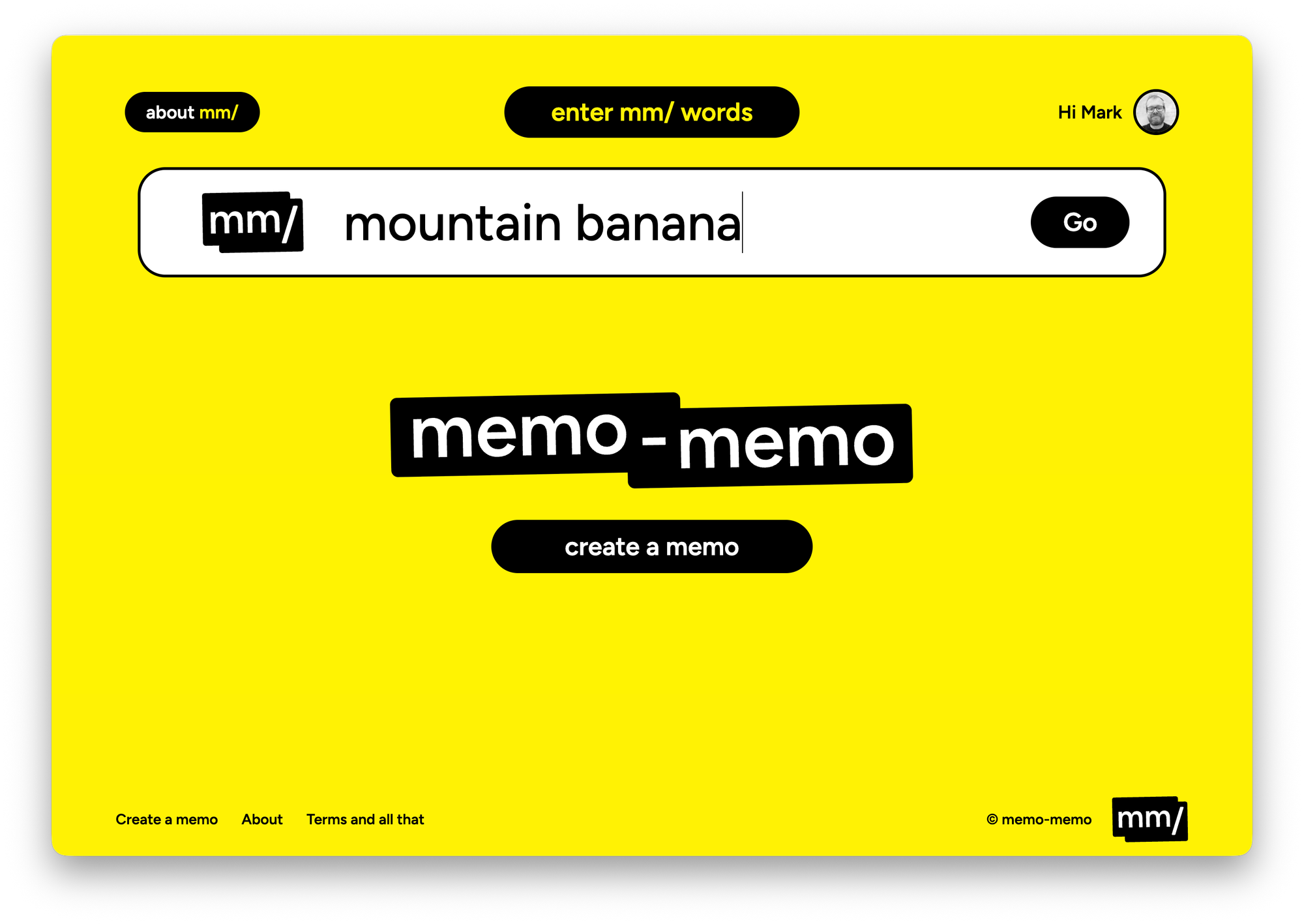
Now go to memo-memo.co and type in those words, 'mountain banana'. (I'll wait.)
Congratulations, you're a memo-memo user! Welcome.
Introducing memo-memo
memo-memo is word of mouth for the web.
It turns any link into a couple of memorable words, like 'mountain-banana'. Think of it as a QR code you can say out loud or write down. Memos are free for anyone to share and follow. Creators and brands can use it to get people to links that can't be clicked.
There's nothing to scan, no app, no account, just two or three words to get you or your audience to where you want them to go.
You can say "memo-memo, mountain banana". Or you can display or write the words down. Use mm/ for short: mm/mountain-banana.
Right, but why?
I'm sure you've noticed URLs are okay to click on a web page, but beyond that are long, technical and impossible to remember. And QR codes, great technology that they are, need a camera or a phone. You need to be standing right next to them, and you also need to trust where they point.
Links are core to anything you want to share. They're fine on a web page or in an app, but they're tricky on podcasts, radio, TV, YouTube, TikTok, posters, the side of a bus, and in conversation. (Basically, they're inadequate anywhere other than on the web.)
Because of this, your favourite podcaster tells you there's a link in the show notes, and brands resort to "Search for this …", but these tactics either fail or hand traffic to competitors who bid on the same keywords.
There’s good evidence that our memories work well with a small number of “chunks” of information. In 1956 the psychologist George A. Miller published a famous paper arguing that we can hold onto about seven chunks in immediate memory. Chunks could be digits, letters or whole words. Nelson Cowan later revised that limit down to about four, but the principle stands. A six-digit one-time password from your authenticator app is about as much as most of us can carry from phone to screen, and it doesn’t last. In a classic 1959 experiment, people forgot most of a short string of letters within 18 seconds when they were distracted. A familiar word is one chunk. It carries a lot more information than a digit, and it can be pictured, said out loud and passed on. Two or three words sit comfortably within our memory's sweet spot, which is why you'll probably still remember “mountain-banana” tomorrow.
How does it work?
Glad you asked. It's super simple.
To follow a memo you see or hear,go to memo-memo.co, and type in the words. You just did that up there. There's no account needed to follow.
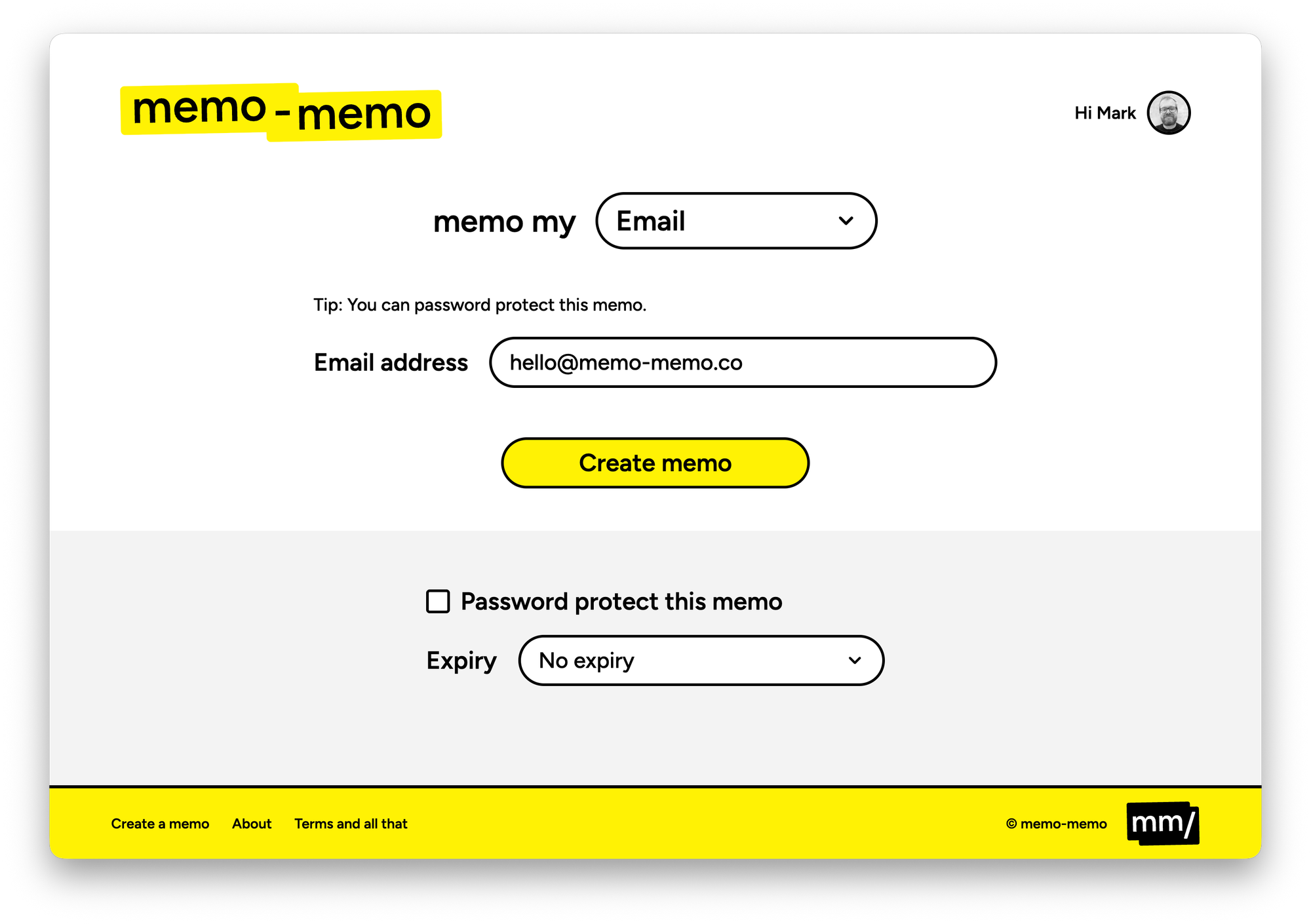
An account is optional when you create. Joining is a good idea because you can manage the memos you make and do things like password protect them.
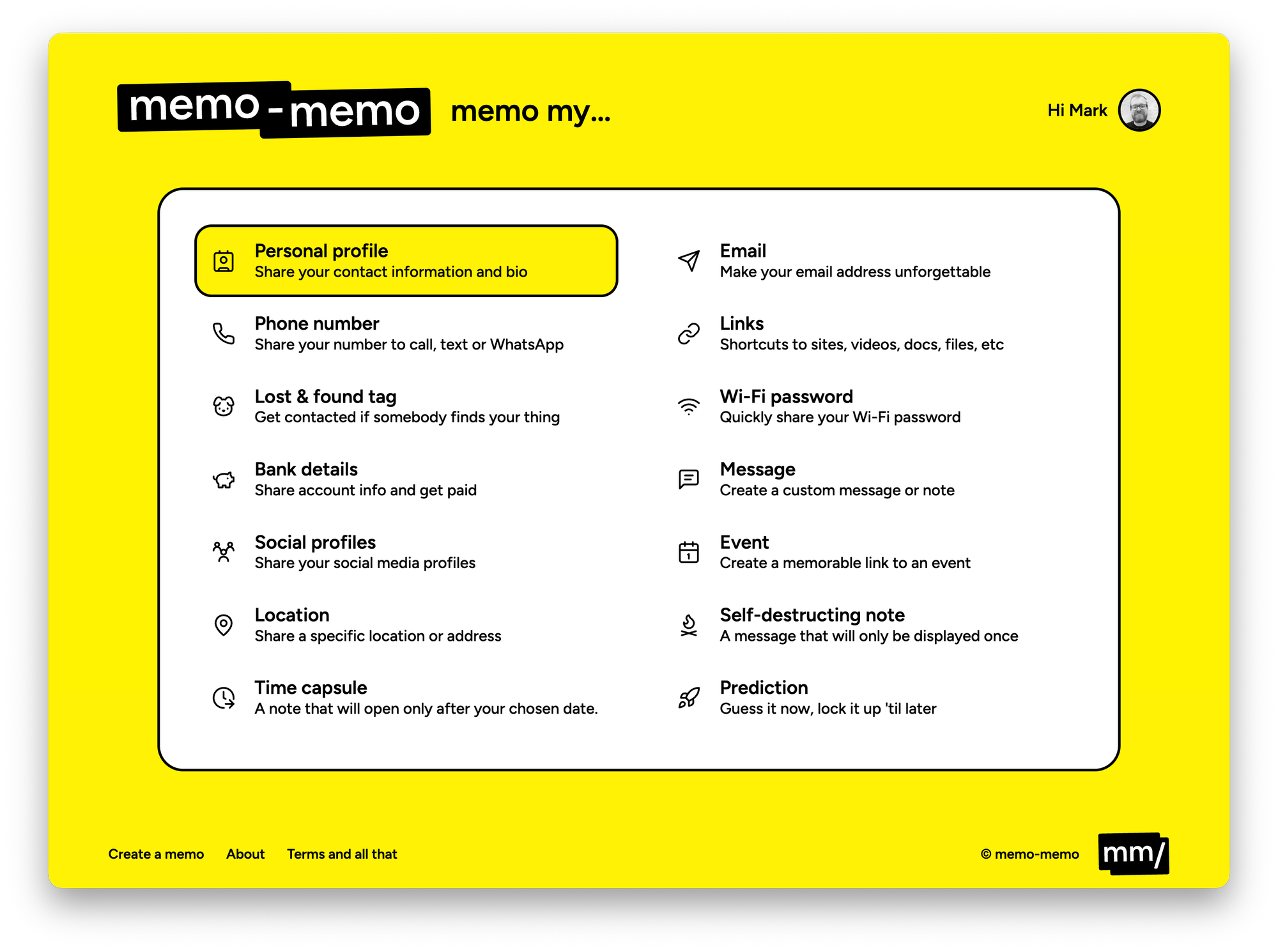
memo-memo is about way more than links. You can choose from loads of different things to share, including bios, social profiles, messages and events. You can create self-destructing messages, a time capsule and tags for your pets and possessions.
You can also do things like make predictions, which seal your memo into the future, so you can prove to everybody that you were right all along.
mm/right-all-along
Add your memo and then share the words. Read them out on your podcast. Show them at the top of your YouTube video. Print them on a billboard. Pop one on your dog's collar so if Mutt gets lost you can be reunited easily. Share one over the phone.
That's it.
Which one are you?
You share things all the time. You want people to go to your social pages, or you're a networker and you want to share your bio and links. Maybe you run a little market stall and want to encourage people to buy your stuff online after they've enjoyed your product.
You read or heard a memo somewhere. It's easy to get to wherever that memo leads. Maybe you heard about an interesting new thingumybob on a podcast. Or your mate in the pub's made a prediction and you really don't think he'll be right.
You make audio or video. You're used to asking people to look in the show notes or in the description for merch, Patreon and episode links. But who reads the show notes?
→ Say the memo-memo words and show them on screen.
You run campaigns. If it's not clickable, how do people get there? Buying search terms is compromised because your competitors are buying the same ones. Or you're trying to grab attention on the side of a bus and the person in that split second needs to know what to do.
→ Design the memo words into your campaign and send users directly to your resource. Email for more info.
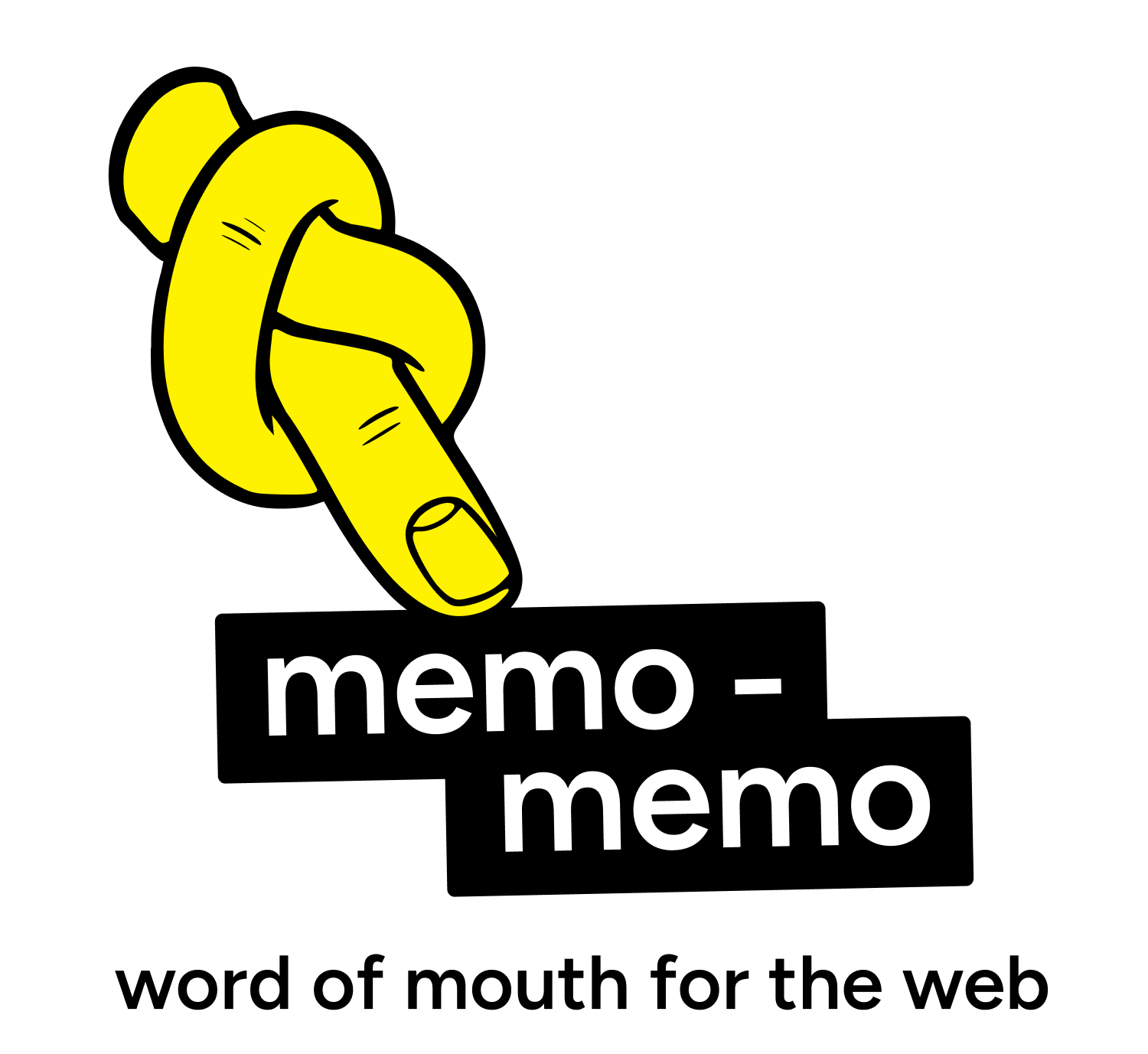
Okay, let's talk about that finger
When you see the finger, don't forget to follow its command.
Use the mm/ mark so your link is recognisable at a glance. You can simply type it or you can use the official graphic.
To share a memo with your vocal cords, just say "memo-memo" and the words. Links work with your eyes closed.
Every memo gets a unique pair or triplet of words. The word list is deliberately built for memorability, and there are no homophones so each memo passes the say-it-down-the-phone test.
Bright yellow and knotted. Remember it!
Where memo-memo came from
One afternoon last year, I was walking along Piccadilly, across the road from St James's Church. Underneath some scaffolding a homeless guy was sitting with a cardboard note asking for money for his hostel stay. But I couldn't give him any because I don't carry any money. I never carry any money. And I thought, how many people actually carry money these days? How will this guy get any money? I wondered, why can't his bank account have a couple of words attached that he could write on his sign and then later, at home, I could give him a couple of quid? A bit like this:
mm/safe-night
Then, as things do, the idea percolated in my head. I realised that bank details were only one thing. Anything I needed to link to, but couldn't click on, had the same problem. Why wasn't there a super simple way of pointing somebody to something I wanted them to see?
In a frenzied week in the summer of 2025, I built about 75% of memo-memo. Originally it was just called link sharing idea, so I gave it a name. I did a bit of the branding work. That's where the yellow was born. I was super busy back then and moved on to another project. But the idea was still lurking in there. And with a second wind, I picked it up again recently and knotted the finger. Now the whole thing works.
memo-memo is a bid for a new convention. It's more than just an app. A bit like hashtags or @handles, memo-memo will get more valuable the more people know about it and use it. And that, my friends, is a tricky startup challenge.
So I thought, what will make it spread? For starters, it must be free for anyone to share and follow memos. memo-memo mustn't track people. Analytics down the line? Maybe, but only to count visits. And since it's super useful for podcasters and YouTubers, I thought creators should come first because every read they make of their memo-memo words teaches the convention to thousands more people. I also happen to be in the UK, so that'll probably be where it first starts. But it's definitely not UK (or English) only.
What’s coming: Tools and additions for creators and brands, a way for AI assistants to follow memos on your behalf (an MCP service). "Hey assistant, can you book a table for two at memo-memo river mouse, tomorrow evening?" Plus webhooks, and visit counts that can tell people and agents apart.
I'm a product builder. As I said in my first blog post, publicity, being conspicuous, and anything that isn't building the nuts and bolts of the product or running the business are challenging. I need to figure out the right way to get the mm/ convention out there, and I want to start those conversations. If you think you can help, I'd love to chat.
Three asks
Make a memo, perhaps for your email address or one of your socials. If you're a creator, try it on one of the links you share.
If you can help me spread the convention, email me.
Tell at least one other person about memo-memo.
And before you go, see where this memo goes: mm/word-of-mouth
Changelog
I thought it's a good idea to keep this post current, as things will change over time. If they do, I'll leave a note here.
Trouble. My x-ray on the hand therapist's smudgy monitor
At the beginning of this year I had an unfortunate accident where I dislocated my right hand ring finger. Since you asked, eight months on it's still healing and has a long way to go. Unfortunately, I'm not a lop-sided left-hander who struggles with scissors, and so everything that requires fine motor skills has been somewhat compromised, not least writing and typing. For a long time, I've had either a splint, a cast or a medieval style torture device to wear, and that has meant all sorts of trouble with my keyboard, including the propensity to hit return too early because my straight, next-to-pinky would dink it midway through a sentence.
I also happen to have worked a lot with lawyers recently and, as I'm sure you know, they like to ramble on a bit. A couple of them put me on to voice-to-text dictation software. They used a well known proprietary one which I tried first. It was impressive, but I prefer not to send my most intimate words off to a service if I can avoid it and I also like the idea of having as much open source stuff in my arsenal as I can. I landed on Handy, and I haven't had to lift a sore finger since.
It takes a bit of getting used to. Give it a fortnight. I naturally ummed and aaahed. I now rarely do that. At first, it really made me feel like I had to have clear, composed utterances before I started speaking. Now I'm able to pause and leave eons of silence to accumulate while I compose my thoughts and get it all out. I expect it's given a real jolt to my verbal fluency.
The worst side effect comes when you're with other people and you can't justify muttering all your inane thoughts to an open room. It becomes a horrendous chore to have to revert to the keyboard.
I've tried probably ten plus different apps, free and paid. Some that link APIs like Groq, others that run a small model locally, which Handy does. (Parakeet Unified is the current one for English speakers.) There are also forks of Handy, which has an MIT licence, that take it a little bit further. But I'm somewhat enamoured by the little rubbery avatar, and I keep going back to Handy.
I've lived a long time where efficiencies are promised and new technologies are heralded as massive time savers. That's mostly been bollocks. But talking at your computer rather than prodding it with your fingers and thumbs has provided solid proof that I can get on with stuff way quicker than I used to.
I wholeheartedly recommend you become a dictator like me.
You know that feeling when you thought you knew how something worked and then you reach a ripe old age and you realise you never actually had a clue? This is how I feel about marketing.
Many years ago, when I was a jobbing designer, I used to worry that people would call me out for 'working in marketing' and back then I thought I did work in marketing. I was communicating. I was enabling people to buy stuff, or for brands to sell stuff, or for users to achieve stuff, or I was letting people know advertising messages. That's marketing, isn't it?
The fact dawned on me recently that this was either merely a very specialised branch of marketing, or possibly not really marketing at all. Maybe it's more visual marketing, or perhaps just plain old comms.
And now I have a problem because I need to be a marketer. I've been whirling round in my little product bubble for too many years, taking for granted the fact that there's a bloody great gaping hole in my knowledge.
It would be alright if I just needed to fake being a marketer. I could probably manage that. I need to actually be one, because without being one, none of the projects I'm fiddling with will ever see the light of day. Like everything else I've created, which, thinking about it is quite a few things over the years, they'll either sit in a drawer with all the others or require somebody else to do the marketing.
Here are the main things I didn't realise about marketing. Or, perhaps more accurately what my current, fuzzy definition of marketing is now that I'm attempting to get a proper grip on it:
It's 100% about people. Ads and copy and designs and stunts and showmanship are the byproduct. By people, I don't just mean customers. Although they're pretty important. It's about understanding people and it's also about the marketer understanding themself and how they communicate with people. In other words, it's a spooky potion of cultural, personal, and self-awareness.
More than people, it's about relationships, and those are multiple as well. There's the relationship between the customer and the product. That's pretty obvious, right? Yeah, I reckon that was what I used to think was all of it. But there's also the relationship between the marketer and the customer, and that one's more tricky. Sometimes the relationship is mediated through the product, through an ad, or through some kind of comms, but more often than not, it's direct and personal. And this seems especially true if you're beginning something or starting from scratch.
And it's also blindingly obvious that it's about publicity, or perhaps a better word for it is exposure. I've thought that all along, but I'd only really considered the outcome (the website, the lauch, the ad) not the human, emotional input. This exposure might be massively public or subtly intimate. A lot of it's about behaviour in a meeting or a call as much as showing up on stage for a keynote.
Then there's the effort angle, which is my current conundrum. I haven't even been able to start properly on this yet. I knew it's about identifying people and finding people, but it's also about getting people to talk to you and then actually going through the act of talking. The idea of that is more exhausting than of pushing pixels or committing code. For that you rely solely on your own feedback and your own challenges, and that of your team. There's not this big wobbly, nebulous, risky other involved. Okay, there's probably a client or a boss, but they're known quantities. The other I'm talking about here might have been completely misunderstood by you, or have their own ideas, or just not give a shit.
I know I've had several thousand real marketing meetings, organised by others, all without really realising what they were, or understanding their substance. That's a good thing because when I know they're coming they petrify me.
So, people who know more than me: What's your definition? How does it work? How can I come to terms with it? And how do I learn more?
I've been trying to reform myself. I'm not sure how well that's going, but I have taken on a new morning habit. It's called Wiki Roulette.
What you do is load a random Wikipedia page, spend one minute reading it and then two minutes presenting back what you've understood as if you're on stage at TED.
I've found that it's extraordinarily difficult. The idea is to sharpen my mind, though I've found it's a bit like dropping a kitchen knife on the floor while you're cooking. You hop in a star jump and twist yourself, hoping not to spill anything while the knife clatters between your feet. But when you pick up the blade, you realise, rather than slicing a tendon, it's so blunt it could only have dealt out a black toe.
I've had a few amazing topics. I think I am discovering how skewed Wikipedia is to the American story. My first was a baptism of historical fire. It was about the Battle of Punished Woman's Fork. This was (recalls from perfect memory) the final battle that the Native American Cheyenne tribe fought against the United States Army in Kansas. They were fleeing their reservation in Oklahoma and were heading towards their homeland in the north. To be honest, I had to look a bit of that up, Just in case I rewrote some history.
It seems Native American history is central to Wikipedia because a couple of days later I got Dryhead Country. I do remember very clearly that Dryhead Country is an area named for all the dusty bison skulls that accumulated at the bottom of a cliff. I did just look it up. The cliff is called Buffalo Jump; of course it is.
Another was biographical, of pioneering British neurologist, Jacob Lockhart Clarke. I felt sorry for him because I immediately forgot his name and dictated the following:
John Something Lockhart was a pioneering British surgeon and neuroscientist who studied and trained at St. Thomas's Hospital in London and later practised in Pimlico. He was responsible for pioneering the idea of close microscopic inspection of the brain and nervous system, which resulted in publications outlining some of the first detailed studies about brain structure and the spinal cord ...
Reading back now, I don't think he was a surgeon, just obsessively into nerves. But he did start it all.
What I've realised with Wiki Roulette is that it's very difficult to comprehend a topic in a minute. And for me at least, it's next to impossible to remember names unless they're London places. People's names? Whoosh! Gone immediately.
But over time the idea is that I'll get extremely good at assimilating information and being able to relay it back coherently. So I'm going to keep spinning the wheel. And the bright side of it, other than being a mental workout that only takes three minutes, is that I can now thrill my family with even more amazing facts.
Here's how to do it
Visit Wikipedia. Under the main menu you'll find a link called Random article. If you click on that it'll give you, well I'm certain you can guess this bit.
You want one that is a single contained idea and probably of reasonable substance. You don't want a massive topic, just a little event or something that's well written up. I've needed to hit Random a couple of times to get one that looks promising.
Start a timer for one minute and get reading.
Top Tip: Though the intro is a great start, don't waste all your time on the stuff towards the top of the page. You probably want to jump down to the fist-fights and accolades. Otherwise, you'll end up giving your talk about somebody's early childhood.
No cheating! No looking back at the article. Stop when the minute is up.
Immediately start a timer for two minutes.
Give your talk. I've been using speech to text software. I can't live without it. If you don't already use it, I recommend this open source app called Handy.
Note down when you run out of stuff to say if you've made it to a minute, I'd say that's good going as a beginner, though I suppose it depends how much you waffle.
If you really want to, you can compare your notes with the real story and marvel at your memory.
Give it a go. I'll be the dull knife on the chopping board for a while yet though, I expect.